
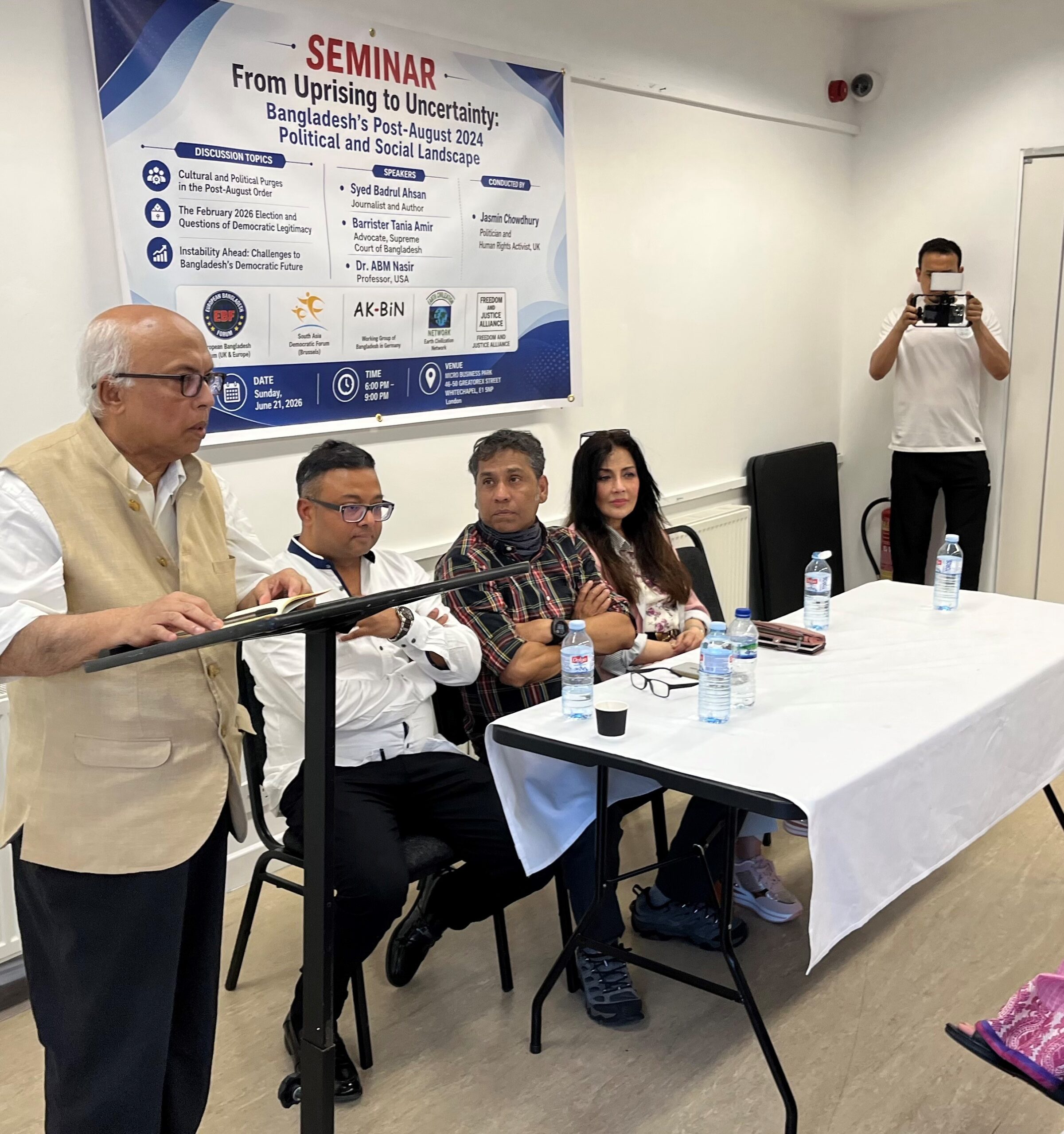
Bangladesh post-August 2024 political landscape seminar held
News Desk
Shottobani
Press Release: Five international and European organisations jointly hosted a seminar titled “From Uprising to Uncertainty: Bangladesh Post-August 2024 Political and Social Landscape” in a community venue in east London, United Kingdom, on 21 June.
The event brought together prominent speakers, including renowned journalist and author Syed Badrul Ahsan, Barrister Tania Amir, Supreme Court of Bangladesh and Professor ABM Nasir from the USA.
Dr Nasir opened the seminar by illustrating the meticulous plan behind the July-August 2024 movement and argued that the 2024 ouster of the Awami League resulted from a failed “minus-two” strategy originating in the early 2000s. He noted that Muhammad Yunus, civil society, and a section of the media conspired with Islamists and foreign actors to reshape Bangladesh, paving the way for the subsequent uprising, political and cultural purges, and political shifts aiming to reshape and erase the country’s Liberation War narratives and post-1971 political order. According to Dr Nasir, the emergence of long-standing anti-establishment civil society networks, alleged coordination between Jamaat and secular anti-government actors, and the rapid political prominence of organised groups following the fall of the Awami League government on 5 August 2024. Dr Nasir points to several developments as requiring further scrutiny: the destruction of more than 450 police stations and security installations during the unrest, attacks on cultural and historical sites associated with the Liberation War, prison breaks that enabled the escape of convicted militants, and the subsequent political rehabilitation of actors previously marginalised by their association with anti-Liberation War politics. He further argued that the movement’s ultimate objective extended beyond the removal of Sheikh Hasina, seeking to revise historical narratives surrounding the 1971 Liberation War and challenge the political framework that emerged from Bangladesh’s independence. Dr Nasir also called for an independent historical and institutional investigation into the planning, execution and consequences of the 2024 political change.
Barrister Tania Amir spoke on the perceived shortcomings of successive pro-liberation governments in upholding the ideals of the Liberation War. She criticised the handling of radical Islamist forces, arguing that policy failures contributed to the entrenchment of extremist elements and an inadequate response to Jamaat. She further raised concerns about the Interim Government’s decision to hold a referendum, questioning its legal and constitutional legitimacy.
Speaking on the occasion, Syed Badrul Ahsan reflected on the long history of intrigues and conspiracies which periodically undermined democracy as well as the foundational principles of Bangladesh. It was surprising, he noted, that neither in August 1975 nor in August 2024 the nation’s various intelligence services were not aware of the sinister efforts that were being made by anti-national elements to overthrow the constitutionally established governments headed by Bangabandhu Sheikh Mujibur Rahman and Sheikh Hasina. Referring to the Yunus regime, he stated it was guilty of high crimes and sedition, and a future Bengali nationalist government will need to ensure that all those parts of the regime or associated with it must face the full force of the law. The Awami League, he emphasised, must shape a credible and well-thought-out strategy to restore the Spirit of 1971. He contended that a second tier of leadership in the party, similar to the one left in place by Bangabandhu and which conducted the War of Liberation, was now an imperative.
The event was jointly organised by the European Bangladesh Forum, Brussels-based South Asia Democratic Forum, AK-BiN Working Group Bangladesh in Germany, Turkish based Earth Civilisation Network and Freedom and Justice Alliance (Global Platform).